Yosi Yair • Founder of Level Plus • May 2026 📖 8 min read
Most cannabis SEO agencies will tell you that ranking on the first page of Google takes six to twelve months. We just proved them wrong, and we have the data to back it up.
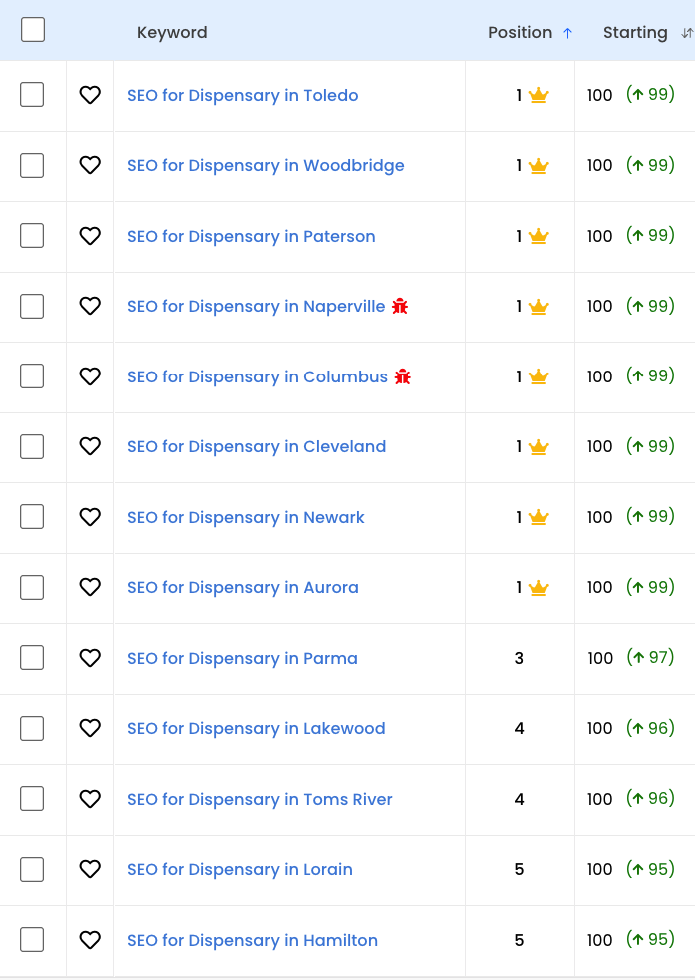
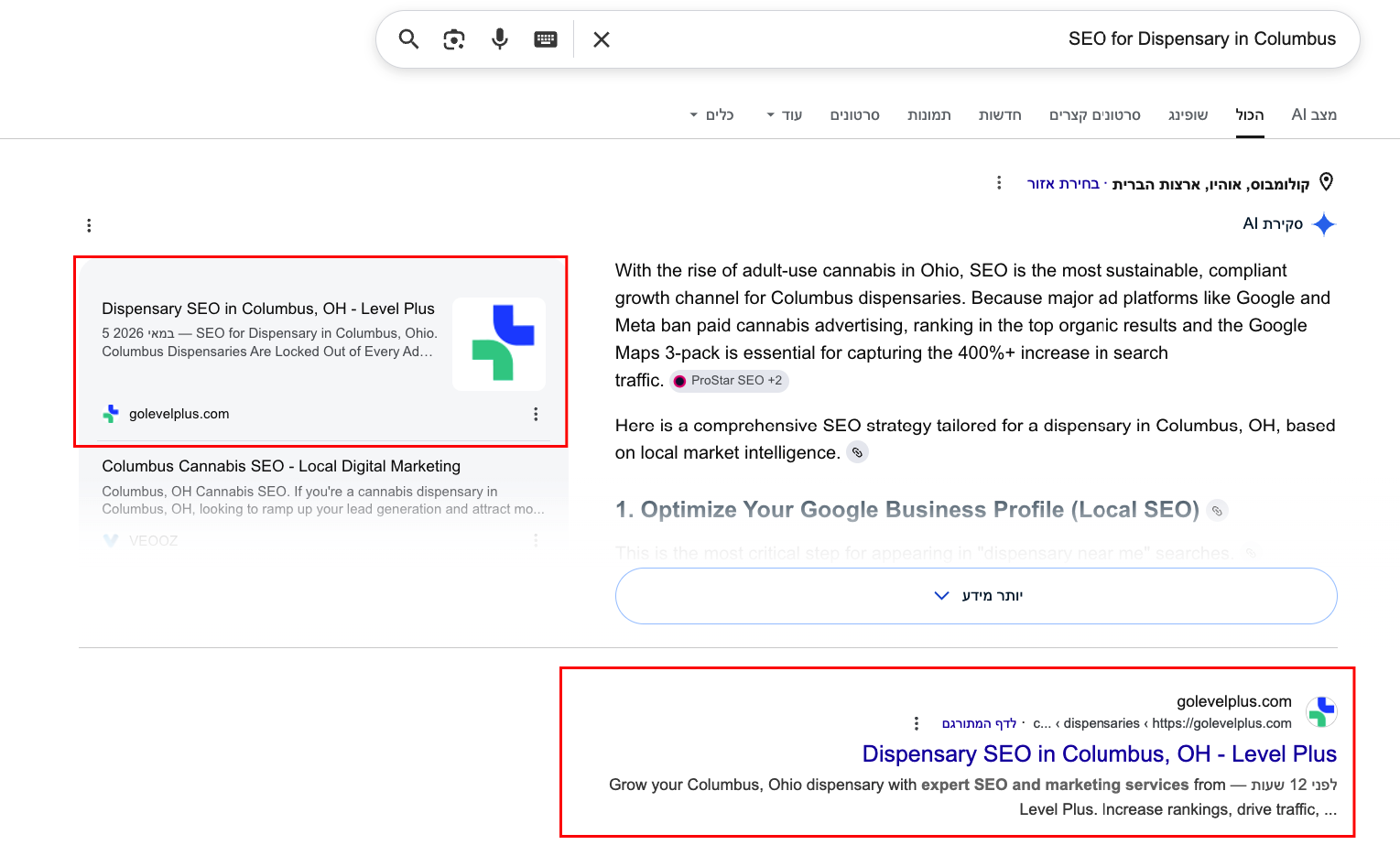
In this case study, I’ll walk you through exactly how our team at Level Plus achieved position #1 on Google for 8 cannabis dispensary SEO keywords in less than 24 hours, with another 5 keywords landing on page one within 48 hours. No paid advertising. No black-hat tactics. Just smart, scalable SEO infrastructure built specifically for the cannabis industry.
The Problem Every Cannabis Dispensary Faces
Every cannabis dispensary in the United States operates under the same brutal reality: Google Ads and Meta Ads are completely banned for cannabis businesses. The moment you try to advertise, your account gets suspended. There are no appeals. There are no warnings. Your money and your account are simply gone.
This leaves dispensary owners with limited options:
- Pay premium prices on Weedmaps and Leafly, renting traffic forever
- Hope walk-in customers find your store by accident
- Master organic search and own your local market
Our challenge at Level Plus was clear. We needed to build a system that could rank dispensary landing pages at the top of Google quickly, reliably, and at scale across dozens of cities simultaneously. Not just one or two pages, but an entire network of high-performing pages targeting different markets.
Our Approach: Programmatic SEO Done Right
Most “programmatic SEO” attempts fail because they create thin, duplicate content that Google penalizes. Walk into most agencies pitching this approach and they’ll show you a cookie-cutter system that publishes hundreds of nearly identical pages. Google’s algorithm catches this immediately, and the penalties can be severe.
We took a fundamentally different approach. Our system was built on four core principles, each addressing a common failure point in scalable SEO.
Unique Value Per Page
Every city page targets specific local intent, such as “Dispensary SEO in Columbus, Ohio,” with content tailored to that exact market. Each page references the local cannabis legal landscape, market dynamics, and dispensary ecosystem. Generic templates don’t work because Google’s algorithm has become sophisticated enough to detect cookie-cutter content. Real local relevance does work, and it works dramatically well.
Technical SEO Excellence
Every page ships with proper canonical tags, structured data using Schema.org markup, optimized meta tags, and fast loading speeds. There’s no technical debt. When you’re trying to rank dozens of pages simultaneously, even small technical issues compound into major problems. We eliminated those issues at the architecture level.
Authority-Centralized Architecture
Instead of spreading SEO authority across multiple domains or subdomains, we consolidated everything under one strong primary domain at golevelplus.com. This means every new city page benefits from the existing domain authority from day one. New pages don’t have to build authority from scratch because they inherit it from the parent domain.
Automation Without Compromise
Our system automatically generates SEO-optimized pages with unique titles, descriptions, schemas, and content for any new city, without requiring manual SEO work for each one. This is what allowed us to scale to 33 cities and counting. The automation handles the technical heavy lifting while the human strategy ensures quality remains high.
The Results: Real Rankings, Real Data
Within 24 hours of launching our dispensary SEO landing pages, here’s what happened.
|
80%
Pages Indexed in 24 Hours
|
8
Keywords Ranked #1
|
5
Additional Page 1 Rankings
|
33
Active City Pages
|
Indexation Speed
80% of pages were indexed by Google in less than 24 hours. The industry average for new pages is two to four weeks. We hit this milestone overnight. This alone is a remarkable achievement that signals to anyone watching the SEO space that something significant happened.
Rankings Achieved
Within 48 hours of indexation, here’s where our pages ranked on Google for their target keywords:
Why These Rankings Matter
To understand why these results matter, you need to understand how Google clicks distribute. Position #1 on Google captures approximately 30 to 40 percent of all clicks for that search query. Position #4 captures around 7 to 10 percent. The difference between being on page one versus page two is enormous because most users never click past the first page.
For dispensaries that depend entirely on organic traffic because paid ads are banned, these rankings translate directly to foot traffic, phone calls, and revenue. A dispensary ranking at position #1 for relevant local searches will see significantly more customers than one ranking at position #10 or beyond.
The 4-Step Framework Behind These Results
Here’s the exact framework we used to achieve these results. You can apply this same framework to dispensary SEO in any market.
Build Authority-Centralized Architecture
Instead of running separate websites for each location or service, we centralized everything under one authoritative domain. The benefits compound over time. All backlinks point to one domain, building authority faster than spreading them across multiple sites. All content lives under one umbrella, creating a comprehensive resource that Google recognizes as authoritative. Every new page launches with existing domain trust, dramatically accelerating time to ranking.
Many dispensary owners make the mistake of creating separate websites for each location. This dilutes their SEO authority and slows down ranking for every page. If you’re operating multiple locations, your strongest move is consolidating everything under one strong domain.
Engineer for Local Search Intent
Generic content doesn’t rank, and we engineered every page to target specific local searches. Each page features a city-specific title that targets exact match queries. The content references specific state laws, market conditions, and local nuances that customers in that area actually care about. Hyperlocal keywords throughout the page mirror how real customers in each city search for dispensary services.
The difference between “dispensary marketing services” and “dispensary marketing services in Cleveland, Ohio” is the difference between competing with the entire country and dominating your specific market.
Implement Bulletproof Technical SEO
Technical SEO mistakes can sink a great strategy. We made sure every page had correct canonical tags pointing to the primary domain. Every page includes Schema.org markup for ProfessionalService and Service types. Page load speeds stay under two seconds. Mobile-first responsive design ensures Google’s mobile-first indexing finds nothing to complain about. Clean URL structures like /dispensaries/[state]/[city] make the site logical for both users and search engines. Proper internal linking connects related pages, helping Google understand the site’s hierarchy.
Optimize for AI Search and Modern SERPs
Google search in 2026 isn’t just about traditional results. We optimized our content to perform across the modern search landscape. For Google’s AI Overview feature, we structured content so AI systems can extract and cite specific sections. For featured snippets, we used question-and-answer formats throughout. For voice search, we wrote in natural language patterns that match how people actually speak. For AI crawlers like GPTBot, ClaudeBot, and PerplexityBot, our robots.txt file explicitly welcomes these crawlers and directs them to our content.
Behind the Scenes: The Technical Architecture
Now let’s get into the technical details. This is where most case studies stop short, but I think it’s worth explaining the actual engineering because it’s what made everything else possible.
The Two-Platform Problem
Our setup involves two separate platforms working together. Our main website at golevelplus.com runs on WordPress, which is excellent for our blog content, services pages, and overall brand presence. But for the dispensary landing pages, we needed something that could rapidly generate and update dozens of city-specific pages without slowing down our main site.
So we built our landing pages on Base44, a no-code platform that runs as a React Single Page Application. This let our team spin up new city pages quickly without writing custom code for each one. The challenge? Base44 runs on a separate subdomain. Out of the box, our city pages would have lived at lp.golevelplus.com, completely separate from our main domain.
The Solution: A Cloudflare Worker as Middleware
We solved this by deploying a Cloudflare Worker that sits between visitors and our infrastructure. Cloudflare Workers are lightweight serverless functions that run at the network edge, intercepting and modifying HTTP requests in real-time. Think of it as a smart traffic controller that processes every request before it reaches the user.
Here’s exactly what happens when someone searches Google for “SEO for Dispensary in Columbus” and clicks our result:
Request Hits the Worker
The visitor’s browser requests golevelplus.com/dispensaries/oh/columbus. Before the request reaches any server, our Cloudflare Worker intercepts it. The Worker recognizes the URL pattern and knows this is a dispensary city page that needs special handling.
Reverse Proxy to Base44
The Worker fetches the actual page content from our Base44 application running on lp.golevelplus.com. The visitor never sees this happen because the URL stays as golevelplus.com throughout the entire transaction. From Google’s perspective and the visitor’s perspective, the page lives entirely on our main domain.
Real-Time SEO Injection
Here’s where the magic happens. The Worker parses the URL to extract the state and city (in this case, “oh” and “columbus”). It then dynamically generates and injects optimized SEO elements into the HTML response: a unique title tag, custom meta description, ProfessionalService Schema markup, Service Schema markup, proper canonical tags, and OpenGraph tags for social sharing.
Sitemap Filtering
The Worker also handles sitemap requests at golevelplus.com/sitemap-dispensaries.xml. It generates a clean sitemap containing only the dispensary city URLs, formatted exactly the way Google expects. This sitemap is referenced from our main robots.txt, ensuring Google discovers every new city page automatically.
The Key Insight: One Domain, Infinite Scale
The result of this architecture is that Google sees one unified domain at golevelplus.com with hundreds of internal pages, all benefiting from the same domain authority. There are no subdomain issues, no duplicate content problems, no split authority. Just one strong domain getting stronger with every new city page we launch.
Automating the SEO Layer
The Worker contains a configuration object that maps state codes to full state names, generates city-specific page titles and descriptions, and produces the appropriate Schema.org markup for each location. When we want to add a new state or new city, we update the configuration and deploy. Every existing and future page in that state automatically gets proper SEO treatment.
This is what we mean by “automation without compromise.” We’re not generating thin, templated content that Google penalizes. We’re applying smart, structured SEO metadata to genuinely useful pages with real local content. The automation handles the technical SEO layer while the content remains substantive and unique to each market.
The robots.txt Configuration
One detail that often gets overlooked is how we configured robots.txt for the modern AI search era. Our main domain’s robots.txt explicitly addresses AI crawlers: GPTBot for ChatGPT, ClaudeBot for Claude, PerplexityBot for Perplexity, OAI-SearchBot for OpenAI’s search products, and anthropic-ai for Anthropic’s training. Each of these gets explicit Allow directives, ensuring our content can be discovered and cited by AI agents that increasingly drive search traffic.
Meanwhile, the Base44 subdomain at lp.golevelplus.com has a robots.txt that explicitly disallows all crawlers. This prevents Google from accidentally indexing duplicate content from the original Base44 URLs while we serve the canonical versions through our Worker on the main domain.
Why We Built It This Way
We could have built everything in WordPress with a custom plugin. We could have used a static site generator. We could have built the whole thing as a custom React application with server-side rendering. Each approach has trade-offs.
The Cloudflare Worker approach gave us specific advantages that mattered for our use case. We could iterate on landing page design rapidly using Base44’s no-code interface. We maintained full SEO control through the Worker layer without touching the Base44 application. We avoided the complexity of running our own server infrastructure. The Worker runs at Cloudflare’s network edge, so it’s essentially free at our scale and incredibly fast.
For dispensary owners reading this who want to apply similar techniques, the takeaway isn’t that you need a Cloudflare Worker specifically. The takeaway is that the right architecture decisions make everything else easier. Spending time getting the foundation right pays compounding dividends as you scale.
Why Most Cannabis SEO Agencies Get This Wrong
If you’ve worked with SEO agencies before and didn’t see results like these, you’re not alone. Most cannabis SEO agencies make the same fundamental mistakes.
Cannabis has unique constraints. Banned ad platforms. Banking restrictions. State-by-state legal differences. Advertising compliance issues that vary by jurisdiction. Generic SEO playbooks don’t address these realities, and applying them to cannabis businesses produces mediocre results at best.
Many agencies will brag about increasing your traffic by 200 percent without mentioning that the traffic isn’t converting to customers. Traffic that doesn’t convert is just expensive bandwidth. We focus on commercial-intent keywords that drive actual store visits and online orders.
Traditional SEO agencies take three to six months to even start showing results. The cannabis market moves too fast for that timeline. Competitors will eat your lunch while you wait for an agency to “build authority” through methods that should have been completed weeks ago.
Generic “best dispensary in [city]” articles aren’t enough to rank competitively in cannabis. You need content engineered for local intent, written by people who understand cannabis culture, and optimized for the way customers actually search. Templates produce template results, which is to say no results at all.
How Dispensary Owners Can Apply These Lessons
You don’t need to be a tech expert to benefit from these strategies. Here’s what dispensary owners should focus on right now.
✅ Audit Your Current Google Presence
Open Google in an incognito window and search for “dispensary in [your city].” Where do you rank? If you’re not on page one, you’re invisible to most potential customers. This is the baseline measurement that tells you how much work you have ahead of you.
✅ Optimize Your Google Business Profile
Your Google Business Profile is the foundation of local SEO for dispensaries. Make sure it’s fully completed with accurate hours, professional photos, and detailed business information. Post weekly updates with cannabis-compliant content. Respond to every customer review, both positive and negative. Make sure you’re categorized correctly in Google’s system.
✅ Build Cannabis-Specific Content
Create content that answers the questions your customers are actually asking. What’s the best strain for stress relief? How do I find a quality dispensary near me? What products are available at your dispensary? When you answer real questions with real expertise, both customers and Google reward you.
✅ Get the Technical Foundation Right
Your website needs to be fast, mobile-friendly, and properly indexed by Google. Most dispensary websites we audit have major technical issues that prevent rankings, even when the content is good. Fix the foundation before trying to build on top of it.
✅ Build Real Local Authority
Get listed in cannabis-specific directories like Leafly, Weedmaps, and Cannabis.net. Submit to local business directories. Earn backlinks from cannabis industry publications. Authority builds slowly at first and then compounds quickly.
Frequently Asked Questions About Cannabis SEO
How long does cannabis SEO take to show results?
Traditional SEO typically takes three to six months to show meaningful results. With our optimized infrastructure, we’ve seen rankings improve within 24 to 48 hours for new pages, though sustainable top rankings typically stabilize over 30 to 60 days. The timeline varies based on market competition, current site authority, and the specific keywords being targeted.
Why can’t I just run Google Ads for my dispensary?
Google and Meta have strict policies prohibiting cannabis advertising. Attempting to run cannabis ads will result in immediate account suspension with no appeal process. This makes organic SEO the only reliable, compliant growth channel for cannabis businesses operating in the United States.
How much should a dispensary spend on SEO?
Quality cannabis SEO services typically range from $2,000 to $10,000 or more per month depending on market competition and project scope. Given that dispensaries can’t run paid ads at all, this investment usually delivers significantly better return on investment than other marketing channels available to cannabis businesses.
Can I do dispensary SEO myself?
Basic local SEO tasks like Google Business Profile optimization and basic content creation can be done in-house. However, technical SEO, content strategy, and link building typically require specialized expertise. This is especially true in cannabis where compliance issues add significant complexity to every marketing decision.
What makes cannabis SEO different from regular SEO?
Cannabis SEO requires understanding industry-specific compliance, banking restrictions, advertising bans, state-by-state legal differences, and specialized content guidelines. Generic SEO agencies often miss these nuances and produce content that doesn’t comply with industry regulations, which can create legal exposure for dispensary owners.
How do I know if my dispensary’s SEO is working?
Track these metrics monthly: organic traffic from Google, rankings for key local keywords, calls and visits from Google Business Profile, form submissions, and ultimately store visits and revenue. Tools like Google Search Console and Google Analytics 4 are essential for tracking these metrics over time.
The Future of Cannabis SEO
The cannabis market is at an inflection point. As more states legalize and more dispensaries open, competition for organic search visibility is becoming brutal. The dispensaries that establish strong organic SEO positions today will dominate their markets for years to come, while those that wait will spend the next decade trying to catch up to competitors who moved first.
Three trends every cannabis business owner should prepare for in the coming year are worth your attention. First, AI-first search is exploding. By the end of 2026, we expect 30 percent or more of search queries to involve AI agents like Google’s AI Overview, ChatGPT search, Perplexity, and Claude. Your content needs to be structured so AI can understand and recommend your dispensary.
Second, hyperlocal domination is becoming non-negotiable. “Near me” searches are exploding, and customers expect to find dispensaries within five minutes of their current location. If you’re not optimized for hyperlocal search, you’re losing customers to competitors who are.
Third, content authority matters more than ever. Google increasingly rewards websites that demonstrate real expertise. Generic AI-generated content won’t cut it anymore. You need cannabis industry expertise, real case studies, and verifiable results to compete at the top of search results.
Get Your Free Cannabis Dispensary SEO Audit
If you own a cannabis dispensary and want to know exactly how to dominate Google in your market, we offer free SEO audits.
We’ll analyze your current Google rankings, identify technical SEO issues holding back your visibility, uncover local SEO opportunities your competitors are missing, and build a custom roadmap to get your dispensary ranking #1 in your market.
⚠️ We work with only one dispensary per market area. Once your competitor signs up, that opportunity is gone